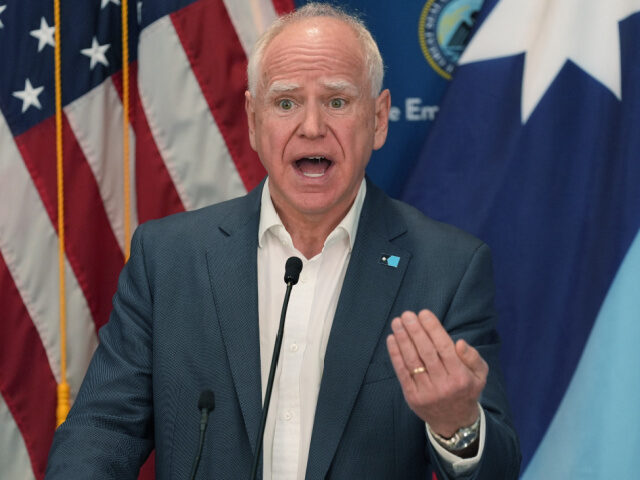
The Minneapolis businesses that exploit illegal migrants should be compensated by ordinary Americans for economic losses amid the federal enforcement of popular immigration and civil rights laws, according to Minnesota Gov. Tim Walz.
“They left us with economic ruin,” Walz complained after White House advisor Tom Homan said on Thursday that he is withdrawing most ICE officers after arresting more than 4,000 illegal migrants in Minneapolis.
Walz said he will give $10 million in Minnesotans’ tax money to the companies that built their businesses on illegal migrants in his “Sanctuary City Economy”:
One of the first things we can do, and what we’re focusing on today, is: What can we start doing on the economic recovery, the damage that has been done to our economy, specifically to small business owners, and even more specifically, to immigrant small business owners … The federal government needs to pay for what they broke here.
“Many Minnesota businesses – especially small businesses — are facing economic hardships that may prove insurmountable” because of the federal enforcement, said Matt Varilek, an economic development manager for Walz. He added:
The massive negative economic impact that is resulting from the fact that a lot of [company] workers don’t feel comfortable showing up, a lot of customers don’t feel comfortable showing up, and so we’re seeing massive reductions in that foot traffic, massive reductions in revenue.
“My customers are afraid to go shopping,” said Henry Garcia, a Colombian migrant who manages a grocery store in St. Paul. His sales fell by half, even though many white Minneapolis residents began to use his store, he said as he stood alongside Walz:
Since federal ICE activity increased late last year, everything changed .. My customers are afraid to go in shopping. … Sales dropped by half, and goodwill doesn’t cover rent … We need more [grants].
Throughout his comments, Walz praised migrants without differentiating between legal immigrants and illegal migrants.
RELATED: Leavitt: Tim Walz and Minneapolis Mayor Frey Sided with Criminals to Harass ICE
The “American Dream” is mostly for migrants, not Americans, according to Walz: “Immigrant small business owners, which … for most of our history, [are] the epitome of the American Dream: ‘Come to this country with nothing and build something to be proud!'”
He continued:
I want to speak directly to Minnesota’s immigrant community, by extension, America’s immigrant community. We see you, we hear you, we value everything that you bring … We believe in those words. “Give us your tired, your poor, your huddled masses, yearning to be breathe free.”
The nation’s American population of 275 million and their children are peripheral to America, said Walz, because “immigration is the core of who we are.”
Walz offered no recognition for American citizens, except those who support migration or who impede ICE operations against illegal migrants. “There is no Minnesota without our immigrant community,” he said.
Minnesota’s Sanctuary City Economic Strategy
Sanctuary Cities generate extra revenue for local governments, investors, and CEOs by importing an economy of illegal migrant workers, consumers, and renters.
The migrants are paid little because they are also much better paid and safer in the United States than in their homeland, and because the federal and state governments provide them with many benefits, such as education for their children and free healthcare.
Advocates for Sanctuary City Economies often praise the emergence of many low-productivity, migrant-run businesses, such as restaurants serving foreign foods to older homeowners who enjoy subservient restaurant staff and high property values. For example, Walz used his speech to claim that migrants have created “a food scene across this state that is second to none.”
The New York Times described a restaurant owner who profited from the Sanctuary City Economy:
Oscar Murcia arrived in St. Paul from El Salvador in 2000, and a few years later started a restaurant and bakery called El Guanaco. He now has four locations, serving mostly Latino customers pupusas and tacos. As ICE activity intensified in December, traffic plunged 80 percent at the Minneapolis location, so he closed it. He has cut hours and staff at the rest of the stores, and asked his landlords and bankers for relief on rent and loans.
Even if customers come back, Mr. Murcia will be missing some of his 64 staff members — four of them were detained, even though he said they had work permits and pending asylum applications.
But American citizens in those cities lose income and status as subservient migrants are steered into jobs by CEOs, into shared apartments by grateful landlords, and into welfare programs by agency employees.
In Minneapolis, average incomes were $52,000 in 2024, while rent spiked to $16,500. Roughly speaking, three full-time, minimum-wage jobs are needed to afford a two-bedroom apartment in Minneapolis, according to a left-wing group, the National Low Income Housing Coalition. In 2023, Minnesota ranked fortieth, near the bottom, in a state ranking of growth in “median household income,” partly because state officials are not prioritizing workplace productivity.
But the economic problems are hidden by the revenue generated by a flood of Biden-era illegal migrants — and by cheerleading from the pro-migration nexus of business, migrants, Democratic elites, and establishment journalists.
Trump’s enforcement of migration law is now ending the peculiar Sanctuary Cities’ institutional exemptions from the popular laws that protect Americans’ civil rights to fair markets for jobs and homes.
His enforcement of Americans’ civil rights fair markets is creating legal shocks in multiple Sanctuary City Economies, such as Los Angeles, Chicago, and elsewhere. Those legal shocks are being felt by landlords, by businesses that employ or sell to migrants, and by the local agencies that rely on property taxes and per-head federal welfare programs.
Minneapolis’s Sanctuary City economy has been boosted by the arrival of migrants from the pre-modern tribal society of Somalia. In Minneapolis, many refugees were encouraged to pirate federal spending programs, often via Minnesota agencies where top Democratic politicians barred oversight and law enforcement.
The imported Somali poverty also became a revenue-generator because the federal governments have lavishly funded the relocation of legal refugees, and those funds are recycled into local rent, autos, groceries, healthcare, teachers, and much else.
In response to reporters on Thursday, Walz insisted that his government be allowed to participate in the federal investigation of the massive, Somali-operated fraud of federal taxpayers. That investigation is expected to expose a large diversion of federal cash into Walz’s Democratic political machine, partly because many Somalis now face jail or even deportation for fraud in their refugee applications.
Meanwhile, President Donald Trump is zig-zagging the nation towards a prosperity economy built on trade, innovation, and productivity. “We’re going to need robots … to make our economy run because we do not have enough people,” he told Breitbart News in August, adding:
So we have to get efficient … we’ll probably add to [the existing workforce] through robotically—it’s going to be robotically … It’s going to be big. Then, somebody is going to have to make the robots. The whole thing, it feeds on itself … we’re going to streamline things. We need efficiency.
The Trump focus on productivity is very different from the Democrats’ favored colonialist-style strategy of human-resources Extraction Migration.
The Democrats’ pushback against Trump’s deportations is an indirect attack on Trump’s low-migration, high-productivity national economic strategy and his 2026 policy on affordability.
Under Trump’s low-migration, high-deportation reforms, Americans’ wages are up, housing costs are down, inflation is declining, transport costs are shrinking, crime is dropping, and corporations are spending heavily to help Americans become more productive and earn more wages for each working hour. His economic reforms, however, are opposed by establishment Republicans and their progressive partners.
RestaurantBusinessOnline.com reported on January 23 that Trump’s deputies are raising voters’ wages by deporting illegal migrants: “Fewer workers mean restaurants will once again have to compete for employees the only way they can, by paying higher wages. Wages over the next two years are expected to accelerate, according to Oxford Economics, from 3.7% this year to 5.6% by 2027.”
The pro-citizen, pro-wage policy is deeply opposed by Democrats, who instead promise to raise living standards for migrants and citizens via government benefits.
COMMENTS
Please let us know if you're having issues with commenting.